EDITOR: A climate of pogrom builds up in Israel
Like in the Russia of the 1880’s, a climate of hatred and fear is building up across Israel, with the burning of mosques, racist graffiti, racist attacks and a multitude of racist events. The government is quite cool about all this, as they stand behind the phenomenon – not behind each nasty racist event, but behind the nasty climate of fear and loathing towards the Palestinian Arabs, either in Israel or in the Occupied Territories. Israel has become what South Africa once was – a society geared up to disable any opposition to its racist rule, and to spread hatred towards the ‘other’, being, like in South Africa, the native of the land, the indigenous population.
That this cancerous growth is spreading at the same time that the ‘tent protest’ is waning is also not an accident. While the tent protesters were careful to avoid any reference to the greatest injustice Israel has ever created, in their fight for justice, it would have been more difficult to spawn this campaign of hate during the ascendancy of the tent protest. Now it is much easier. After a ‘summer of hope’, follows the winter of racism.
Israel sees increasing incidents of anti-Arab hate graffiti: Haaretz
Hate-graffiti reported across Israel after Tuba-Zangaria mosque arson last week; Police Commissioner meets with Muslim, Christian community leaders after tense weekend in Jaffa.
Jaffa was quiet on Sunday following a tense weekend in which vandals spray-painted slogans such as “Death to Arabs” in two cemeteries – one Muslim and one Christian – and hurled a Molotov cocktail at a synagogue.
Police Commissioner Yohanan Danino sought an urgent meeting with the leaders of Jaffa’s Muslim and Christian communities on Sunday, and the meeting was quickly set for that evening in Jaffa. By the time it occurred, police had also learned about similar graffiti in nearby Bat Yam, along with new slogans such as “There will be no Arabs on Maccabi Haifa” (a soccer team) and “Death to Russians.” But Bat Yam residents say this graffiti is more than two weeks old.
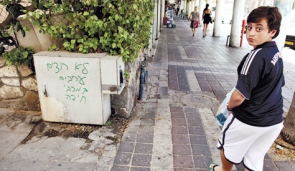
Police said that ever since last week’s torching of a mosque in Tuba-Zangaria, in northern Israel, they have been receiving reports of hate-graffiti from all over the country.
Prior to their meeting with Danino, Jaffa leaders met among themselves to formulate a list of demands they planned to present to him with the goal of bolstering security in the city. They agreed that the city’s Arabs felt threatened, and some even said they feared Arabs would soon be attacked en route to prayers at local mosques.
Danino prepared by receiving a briefing on the investigation from Tel Aviv and Jaffa police officers. The police’s current thinking is that even though one of the spray-painted slogans was “price tag,” a phrase usually associated with right-wing extremists, the vandalism was not ideologically motivated, but was rather the work of local hoodlums, possibly soccer fans.
Danino opened his meeting with Jaffa’s leaders by telling them, “I was born in Jaffa and spent much time there as a child. I’m very familiar with the city’s coexistence and fabric of life.”
He then said the force has have recently been working to “bolster policing and service in Arab communities.”
“We view the incident that took place here as a grave one,” he said. “The incident will be dealt with at the highest level; we’ll make every effort to find the perpetrators and bring them to justice. Our top people will be devoted to this matter. I ask the community to continue to aspire to coexistence and a shared life while upholding law and order.”
The community leaders said afterward that they would prefer less talk and more action.
Earlier yesterday, Tel Aviv Mayor Ron Huldai also met with leaders of Jaffa’s Arab community and denounced the cemetery vandalism harshly.
“I expect the hands of those who commit such acts to be chopped off,” he said, speaking figuratively. “But our job as public figures is to sit together and resolve the issues, as we have invested enormous efforts in recent years in maintaining life as usual here. The Jaffa public was always more mature than all the extremists, and we’ll find a way to return to normal, despite the provocations.”
Sheikh Saliman Setel, who heads the Islamic Movement in Jaffa, termed the meeting with Huldai positive and pledged to do his best to calm tempers in the city.
“For now, the situation is calm; there’s nothing special happening,” he said. “We don’t want this to be temporary. Such things happen every year or two, and it’s not acceptable to anyone. We live in coexistence; we don’t want problems. Just as we respect everyone’s holy sites, we want others to respect our holy sites.”
Empire – Palestine state … of mind: YouTube
Watch this comprehensive examination of the international effort to stop the Palestinians from having their state.
In Jaffa, Israeli racism towards Arabs is routine: Haaretz
The problem in Jaffa is not that some kids scrawled ‘Death to the Arabs’ on a grave, but the racist treatment Arabs receive on a daily basis; Israel’s Arab minority is treated as an enemy.
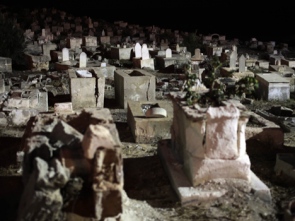
A meeting between the head of the Israel Police and a group of Arab notables is never something that sounds good. I come to the well-kept community center in the Arab Ajami neighborhood in Jaffa where the meeting is to take place. A Christian notable with a huge gold cross comes through the door while a correspondent for the British newspaper The Guardian checks with the tall reporter from the Ynet website as to what exactly is going on.
Then in comes Israel Police Commissioner Yohanan Danino, with an entourage of other senior police officials. As Danino smiles, spokesman’s office staff try to get the reporters and cameramen out of the room. “I came for a private talk. No media,” the police commissioner announces, as if the substance of this whole meeting isn’t media-related.
Ahmed Abu-Kutub, who is the event operations director at the Tel Aviv Hilton hotel and has worked there for 30 years, stands outside. He came to the community center for his son, who is a reporter for an Arabic language website called Yaffa48.com. “How will this help?” the Hilton employee asks, referring to Danino’s visit. He was offended by the graffiti discovered on Muslim and Christian graves in Jaffa over the weekend, calling it a serious matter.
“We grew up with Jews. To me, you’re a human being. That’s how we were taught at home. A person has died. What do you write on his grave? All kinds of nonsense?” Abu-Kutub remarked.
“It’s all racism. That’s the government and the police,” Abu-Kutub’s son, the reporter, says but Ahmed responds: “How are the police guilty?”
I make my way to the Jaffa protest tent encampment, which is one of the most impressive institutions to come out of this summer’s protests. It was exciting to see how important it was to the Arab and Jewish leadership of the Jaffa encampment to be in touch with leadership from the Hatikvah quarter protest camp. It’s the beginning of solidarity as great as the social protest struggle itself.
I seek out someone to interview there and am referred to Samer Kassem, who was photographed on video being beaten by police in a clip that provided shocking Internet footage a few days ago. His story never made headlines because people are more shocked by symbols than people whose ribs police fracture. The incident occurred while police were evicting Kassem from an abandoned house in which he was squatting with his sister.
“When they came to evict us from there, I started packing. I knew [the house] was just a temporary solution. I asked the officer one question. ‘Do you have an eviction order?’ Then he called over the Yassam [special forces police] and said: ‘Take care of him.'”
Samer works in home remodeling and sees the irony in his situation. “I make homes beautiful, but I have no place to live,” he says.
I ask him how he can work with broken fingers. His ribs hurt him a lot more, he replies.
The real problem in Jaffa is not that a few kids scrawled “Death to the Arabs” on a grave, but rather the racist treatment accorded the Arabs on a daily basis. It’s a fact that this minority here is related to by the media and the state as the enemy. The Israeli establishment simply relates to Arabs here with violence and racism, even if it is elegantly concealed to a greater or lesser extent.
Israel Police arrest suspect in Galilee mosque arson: Haaretz
Man detained within hours of the incident, which police believe may have been a ‘price tag’ attack carried out by extreme right-wing Jews; suspect denies involvement.
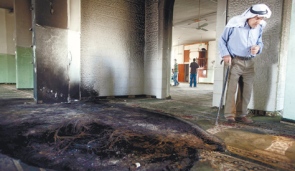
Israel Police have arrested a man suspected of involvement in the torching of an Upper Galilee mosque earlier this week, it emerged on Thursday.
The suspect arrested just hours after the attack, but a gag order was slapped on all investigation details immediately following the incident. The suspect was brought before the court for a hearing on his remand Thursday, where an attorney representing the suspect said his client disavowed any link to the incident.
Legal representation to the suspect is provided by the Hanenu organization, which provides legal counseling to those prosecuted over acts committed during military service in the West Bank and as part of right-wing political activity.
The mosque in the village of Tuba-Zanghariyya, a Bedouin town of some 5,500 people two kilometers east of Rosh Pina, was attacked at about 2:30 A.M. on Monday morning. The mosque’s interior was seriously damaged, and many holy books were destroyed by the blaze.
Police suspect that extreme right-wing Jews carried out the arson as a “price tag” operation, referring to vandalism and revenge actions initiated by activists, usually against Palestinians, following terror attacks or state demolitions in settlements or outposts.
On Wednesday, the ultra-Orthodox newspaper Yated Ne’eman condemned the arsonists who torched the Tuba-Zangariya mosque, saying said the “din rodef” law applied to them, meaning it is permitted to kill them to prevent them from endangering others.
“Jews don’t burn mosques, period,” the newspaper’s editorial said. “…no shadow of justification can be found for harming a Muslim mosque. This is an insane, dangerous act.”
Palestinian security prisoners across Israel to join PFLP in hunger strike: Haaretz
Popular Front for the Liberation of Palestine launched hunger strike on September 27 to protest isolation of senior Palestinian prisoners.
Security prisoners in all Israeli prisons plan to announce on Monday that they are joining the hunger strike declared by jailed activists of the Popular Front for the Liberation of Palestine and the hundreds of other prisoners who have identified with them, including Israeli Arab security prisoners.
The hunger strike was launched on September 27 to protest the isolation of several senior Palestinian prisoners, among them the PFLP’s general secretary, Ahmad Saadat.
An announcement released on Sunday by inmates in the Gilboa Prison said that security prisoners had decided to join the strike until their demands were met, among them a halt to the policy of solitary confinement and the upholding of prisoners’ rights, which they said had been won after a difficult struggle that took place over many years.
The Israel Prison Service has been conducting talks with prisoner leaders in every prison in an effort to prevent any collective decision. The IPS said that the policy on solitary confinement is set by the political echelons, but that one suggestion – that all prisoners in solitary confinement be kept in the same guarded area of the prison – may be acceptable to the prisoners.
The prisoners’ demands have started to garner support outside the prisons. There are solidarity marches scheduled for tomorrow in several cities in the West Bank and Gaza, and the Solidarity Committee for Prisoners has declared Friday to be a day of solidarity with the hunger strikers.
Dateline Jerusalem: four decades of journalism still relevant today: Guardian
Collection of articles by former Guardian correspondent Eric Silver evokes a different era of reporting

I’ve been dipping into a collection of the journalism of the late Eric Silver, who was based in Jerusalem for nearly 40 years until his death in 2008, reporting for the Guardian, Observer, Independent, Jewish Chronicle and others.
Dateline Jerusalem, which will be published next week, inevitably covers globally important events – including the aftermath of the 1967 war, the Yom Kippur war of 1973, peace with Egypt, the first and second intifadas, the Oslo accords, Yasser Arafat’s return and Camp David.
But it’s the impressionistic and observational pieces that I really loved, evoking a different kind and pace of journalism – reflective, rich, textured and, yes, slower – than that which predominates today.
I never met Eric; he left the Guardian in 1987, two years before I joined its staff, and he died from pancreatic cancer two years before I arrived in Jerusalem. He was the Guardian’s correspondent here for 11 years, before moving to become the paper’s Delhi correspondent for a few years. After that, he declined to move back to London with the Guardian, instead making aliyah to return to his home in the centre of Jerusalem – more of which below – and the insecurities of freelancing.
Some of the pieces that I’ve read so far have left me feeling how little things change here. This description of Gaza from 1993 could easily be cut-and-pasted into a piece in 2011, bar the figure for Gaza’s population – 720,000 – which has more than doubled, making the tiny scrap of land even denser.
The little boy, a tableau glimpsed through a car window, looks about four years old. He stands alone in bare feet and ragged shirt on a street-corner garbage dump in Gaza city glumly waving a red, green, black and white Palestinian flag at no one in particular….
The main roads are rutted and overflowing with sewage. Most of the back lanes of the towns, villages and refugee camps are unpaved tracks through the sand. The stinking refuse on every patch of spare ground looks as though it hasn’t been collected since the intifada exploded almost six years ago…
Outside a gas station in the Shati camp, home to more than 40,000 refugees, half a dozen men in their mid-20s are loafing on white plastic chairs. Do they expect things to get better? ‘Inshallah,’ shrugs one of them, Nasser al-Shram, a 27-year-old driver; ‘God willing’…
What future do Nasser and his friends see for their families? More shrugs. What dreams do they have for themselves and their children? It’s as if they don’t understand the question. Pressed for an answer, one of them spits back: ‘What do you want me to say? That I want to be a pilot?’
In another piece, entitled ‘Where and who are the Jewish settlers?’, from 2003, Eric talks to both the “quality of life folk [who] wanted a nice house with clean air at a price they could afford, thanks to government incentives” and the “ideologues [who] wanted to ‘redeem’ the ancient homeland for the Jewish people”. In a piece which speculates whether settlers will resist evacuation in any peace deal with the Palestinians, and describes a “climate of violence” in the West Bank, again only the figures have changed over the eight years since publication. At the time of the article, there were around 220,000 settlers in the West Bank and Gaza; now there are none in Gaza but more than 300,000 in West Bank settlements and outposts and around 200,000 across the Green Line in East Jerusalem.
[Ariel] Sharon, once the patron of the settlement enterprise, recently broke a taboo and labelled the territories ‘occupied’… Mr Sharon said Israel could not go on ruling 3.5million Palestinians. He hinted at evacuating settlements and sites sacred to the Jews. The settlers, the first to take his words at face value, are bracing for a moment of truth.
Yet their anxiety is on hold. They doubt whether the Palestinians, from Yasser Arafat and Prime Minister Mahmoud Abbas down, are reconciled to the existence of a Jewish state alongside them. They expect the international ‘road map’ to fail, just like Oslo. In any case, they parade good reasons, historic, theological, strategic, why they think their particular community will be spared….
The early settlements were built by Labour government, most of them along what were seen as Israel’s future strategic borders… [Menachim] Begin, energetically supported by Mr Sharon, changed all that. To prevent any ‘repartition’, he deliberately sowed settlements among the Arab towns and villages of the West Bank hill country.
The book includes an appreciation by the historian Sir Martin Gilbert, an introduction by the Independent’s Don Macintyre, and and afterword by the Guardian’s Martin Woollacott. Don, who worked with Eric from 2004 until his death, writes with great warmth:
We didn’t always agree of course; life would have been less interesting if we had… Israel was [Eric’s] adopted country, and as an Israeli he was probably less impatient than a few of his fellow correspondents, including me, at what we saw as its chronic disinclination to take dramatic steps needed for the region’s lasting peace and security.
But his Zionism was also that of a deep-dyed Labour Party man (which he had also been in Britain) who believed that division of the land was necessary for peace… He was moreover unflinchingly objective when he saw failings of Israeli policy or conduct, as he often did.
Eric lived with his wife Bridget in the Street of the Prophets in the centre of Jerusalem, in a 19th-century thick-walled house with vaulted ceilings, set in a “big unruly garden, part Mediterranean, part desert, a wilderness of pines and pomegranates, of giant cactus, prickly pear, bay leaves, loquats, bitter almonds, figs, cypress and bamboo, all surrounded by an eight-foot stone wall against the ravages of Bedouin marauders.”
I went to this extraordinary house last week to have tea with Bridget and pick up a copy of the book. She has spent two years selecting from Eric’s copious output for this collection, a labour of love and a legacy to his life’s work. Although Eric was the author of several books, he didn’t really like book-writing, she told me; his love was for journalism. That is evident from Dateline Jerusalem.
Dateline Jerusalem by Eric Silver, published on October 17 by Revel Barker, price £15.99
The Israeli government is fooling you: Haaretz
The Israeli government website and an official Quartet declaration say that ‘Israel welcomes the call’ by the Quartet ‘to conduct preliminary, unconditional and direct negotiations with the Palestinian Authority’; who are they fooling?
Did you know that Prime Minister Benjamin Netanyahu has just welcomed a diplomatic plan that posits the borders of June 4, 1967, as a basis for negotiations with the Palestinians, along with mutual and consensual territorial exchanges? Did you hear that Foreign Minister Avigdor Lieberman (Yisrael Beiteinu) welcomed the demand to freeze construction beyond the Green Line entirely, including in East Jerusalem? Were you told that Deputy Prime Minister Moshe Ya’alon (Likud) welcomes the demand for the immediate dismantling of all the outposts built in the past decade? Has anyone told you that Ministers Eli Yishai (Shas) and Daniel Hershkowitz (Habayit Hayehudi) have given their blessing to negotiations on the status of the holy places in our united capital?
And that’s not all. All the leaders of the coalition, without exception, have just now informed the entire world, and the entire Jewish people of course, that they recognize the importance of the Arab peace initiative, which offers Israel normalization in return for withdrawal from all the territories, including the Golan Heights, and a fair and consensual solution of the refugee problem, on the basis of UN General Assembly Resolution 194.
No, this is not the end-of-days vision of a delusionary defeatist. The exciting news is taken from the Israeli government website and from the official declaration of the Quartet from September 23. The website says that “Israel welcomes the call by the international Quartet to conduct preliminary, unconditional and direct negotiations with the Palestinian Authority,” and that it will raise its reservations during the course of the negotiations.
Let us examine what was said in that “call” that Israel “welcomed.” Such an examination is apparently essential, since even Prof. Shlomo Avineri failed to get to the bottom of the “welcome” for the Quartet’s declaration. Otherwise, he would not have presented the Quartet’s plan as a “diplomatic achievement for Israel,” which exposes the Palestinians as the “recalcitrant party” (“No realistic chance of permanent Middle East peace” – Haaretz, October 5 ).
The Quartet’s declaration does indeed call on the parties to renew negotiations without preconditions – without preconditions, but with clear sources of authority, based on a series of declarations, decisions and international agreements. First, it says there that the Quartet ratifies its decision of May 20 this year, which includes clear support of the vision of peace presented by U.S. President Barack Obama. This is the decision that adopted Obama’s May 19 speech, in which he called for the renewal of negotiations on the basis of the 1967 borders, with mutual and consensual territorial swaps.
Later, the Quartet’s “welcomed” announcement says that the international foursome confirms its determination to reach an overall solution to the Arab-Israeli conflict, based on a series of UN Security Council resolutions. One of them – Resolution 1515 of November 2003 – adopted (and not only “welcomed”) the Road Map peace plan.
We can assume that MK Benny Begin (Likud), who makes sure to read and warn about every dubious word in the speeches of Palestinian President Mahmoud Abbas, reminded his friends in the so-called forum of eight senior ministers that in the Road Map, Israel promised to freeze the settlements entirely, to dismantle the outposts, and to reopen the Palestinian institutions in East Jerusalem – and all this on the way to an agreement that will end the occupation that began in 1967 and realize the two-state vision.
We are therefore left with the question: Who are they fooling? Coalition chairman Ze’ev Elkin, who declared that Jordan is Palestine, and MK Danny Danon (Likud), who declared that there is no room for two states between the sea and the Jordan? Or perhaps they are misleading U.S. Secretary of State Hillary Clinton and European Union foreign policy chief Catherine Ashton, who signed the Quartet’s declaration?
If the members of the forum of eight have undergone a dramatic ideological upheaval, is it possible that they didn’t tell the Knesset or, unfortunately, the government plenum? Perhaps they relied on the fact that the Palestinians would do the dirty work for them and reject the outline on the threshold of the negotiating room. After all, there are people who have already decided that the story is over and are accusing the Palestinians of causing the plan to fail.
Fortunately, Abbas announced to the European Council last Thursday the “positive stance” of the Palestinians regarding the Quartet’s announcement. We can only hope that the Quartet will finally force Netanyahu to put his cards on the table.
Cairo clashes leave at least 24 dead: Guardian
Military police blamed for using excessive force as protest march by Christians over church attack erupts into violence
At least 24 people were killed in clashes between police and Coptic Christians in Cairo on Sunday Link to this video
At least 24 people have been killed and more than 200 injured in the centre of Cairo after a protest over an attack on a church erupted into the worst violence since the 18-day uprising that ousted Hosni Mubarak as president of Egypt in February.
Trouble began when a demonstration against the attack in southern Egypt was reportedly met by gunfire close to the state television building.
Fighting spread to Tahrir Square and surrounding streets. Hospitals where the wounded were being treated also came under attack.
State television announced that a curfew was being imposed on the city’s downtown area and Tahrir Square, the epicentre of the February uprising that overthrew the former president. The curfew would last from 2am to 7am (midnight to 5am GMT) on Monday.
Appealing for calm after more than 1,000 security force personnel were deployed, interim prime minister Essam Sharaf said: “What is taking place are not clashes between Muslims and Christians but attempts to provoke chaos and dissent.”
“The only beneficiary of these events and acts of violence are the enemies of the January revolution and the enemies of the Egyptian people, both Muslim and Christian”
Coptic Christians make up approximately 10% of the Egyptian population, and some have been fearful that Egypt’s ongoing political turmoil could allow ultra-conservative Islamists to flex their muscles and inspire a crackdown on social minorities. There has also been criticism of the army for being too lenient on previous attacks against Christians, with many witnesses accusing soldiers of being actively complicit in last night’s bloodshed.
Egyptian troops are among the dead following the violence, which comes after several outbreaks of sectarian tensions this year
“We were marching peacefully,” said Talaat Youssef, a 23-year-old Christian trader. “When we got to the state television building, the army started firing live ammunition,” he added.
Another protester, Essam Khalili, said: “Thugs attacked us and a military vehicle jumped over a sidewalk and ran over at least 10 people,” he said.
Online, Egyptians queued up to blame the ruling military council for fomenting the violence, accusing army generals of using social instability as an excuse for cracking down on freedom of expression. “Let there be no doubt, today’s killings are committed by #SCAF [the ruling military council]. They are the killers,” wrote one Twitter user.
State television put the number injured in the violence at 150, saying three of those killed were soldiers.
More than four vehicles were set on fire and TV footage showed protesters breaking windows of parked cars and army personnel carriers driving towards crowds.
“What happened today is unprecedented. Seventeen corpses were crushed by military trucks,” human rights activist Hossam Bahgat said.
In May, twelve people were killed in clashes between Christians and Muslims after rumours that Christians were holding a woman who had converted to Islam. The incident led the country’s ruling military council to order the drafting of new laws to criminalise sectarian violence.
EU summit on Arab Spring overshadowed by deadly Egypt violence: Haaretz
European Union Foreign Ministers express concern over overnight clashes between Coptic Christian protesters and the army in Cairo, which left 24 dead.
Overnight clashes between Coptic Christian protesters and the army which left 24 dead in Egypt cast a shadow over a meeting Monday of European Union foreign ministers which was meant to discuss the bloc’s response to Arab Spring uprisings.
“Egypt needs to reform politically and economically against a backdrop of recognizing that what has happened in the Arab Spring now needs to turn into a real democracy,” EU foreign policy chief Catherine Ashton said before the meeting.
The EU would express “concern for the people of religious minorities who have been attacked,” Ashton said, adding that “freedom of expression and belief is absolutely fundamental to human rights.”
British Foreign Secretary William Hague told reporters that “the whole world” was waiting on Egyptian authorities “to reaffirm freedom of worship.
Egypt was second, after Tunisia, in the sequence that led to the toppling of authoritarian Arab rulers. While the democratic transition is seen as advancing relatively smoothly in Tunis, there are concerns about the army-led process in Egypt.
“We really do expect that Egypt will move towards elections,” Ashton stressed.
EU ministers were also expected to adopt fresh sanctions against Iran, expanding an existing travel ban and an asset freeze list currently targeting 32 officials. “We are discussing additional measures on top of those already taken,” Hague said.
Fresh sanctions were also expected against Belarus, in the wake of its walkout from a Warsaw summit between the EU and its eastern neighbours on September 30, while a new round of restrictive measures against Syria was still being debated.
French Foreign Minister Alain Juppe confirmed that European governments would reach out to the opposition Syrian National Council, despite threats from President Bashar Assad’s regime to retaliate against any country which did so. “We would like to have contacts with the Syrian opposition,” he said. “We are happy to see that the opposition is getting organized.
Spanish Foreign Minister Trinidad Jimenez said the EU ministers were not talking about recognizing the Syrian opposition but wanted for “the first time” to acknowledge the existence of the council in the conclusions due to be adopted later Monday.
Italian Foreign Minister Franco Frattini sounded a note of caution on the council. “A lot of countries do not know well enough who they are and what are their plans, their proposals and, possibly, their roadmap,” he said.
Ashton said the Luxembourg meeting would also serve to prepare an EU response to the trial of Ukraine opposition leader Yulia Tymoshenko, where a verdict is due to be delivered Tuesday.
Jerusalem light railway a new source of Jewish-Arab tension: Haaretz
Incident, first in which pepper spray was used, comes following numerous reports of confrontations between Jewish and Arab passengers.
Security guards on Jerusalem’s light rail used pepper spray on Arab passengers during a clash that occurred on Wednesday after the train supervisor asked the passengers to remove their feet from the seats.

The incident, the first in which pepper spray was used, comes following numerous reports of confrontations between Jewish and Arab passengers.
Most of the clashes, which police say are not reported, take place in the area of the Arab neighborhood of Beit Hanina and the Jewish neighborhood of Pisgat Ze’ev.
After the passengers, young Arab men, refused to take their feet off the seat the supervisor called in train security guards. A melee ensued, in which the guards sprayed the young men and took them off the train.
Police who were called to the scene made no arrests, since no complaint was lodged.
A Pisgat Ze’ev resident, who gave his name as Tzion, said his children were accosted on one occasion by Arab teens who cursed them and showed them a bag that they said contained drugs.
In another case, police arrested four Palestinians for throwing stones at the train.
But Ahmed Mustafa Sub Labaa, a field researcher for the Jerusalem non-profit organization Ir Amim, said Palestinian passengers have also complained of attacks by Jews. In one case, three Palestinian children said they were attacked three weeks ago by a number of Orthodox passengers during an argument over seats.
One Pisgat Ze’ev resident said he thought the problem was that the train is still free, which makes it an attraction for bored young men, both Jews and Arabs, looking for trouble.
“I would describe the situation as ‘birth pangs’, said Jerusalem city councilwoman Yael Antebi, adding that she has received numerous reports of fistfights and violence. “These are groups that don’t fit together harmoniously and all of a sudden are put together,” she added.
Ir Amim’s policy advocacy director, Oshrat Maimon, wrote Yehuda Shoshani, the CEO of the light rail franchisee City Pass, that the company should regard the encounter between the two groups, “happening for the first time intensively on a transportation system” as a challenge to “make clear that everyone has a right to the services of the light rail” and to decry violence.
The Jerusalem municipality, which is responsible for security on the train, responded that since the train started running, “there had been only a few violent incidents, mainly involving young people, not necessarily connected to ethnic affiliation.”
France FM: Palestinian statehood bid starting to create cracks in European unity: Haaretz
EU member states cannot come to agreement on Palestinian UN move, says Alain Juppe; Catherine Ashton says no division among EU countries regarding renewal of Mideast talks.
The Palestinians’ bid for statehood is starting to create cracks in European unity, French Foreign Minister Alain Juppe said Monday, after discussing the issue with his European Union counterparts in Luxembourg.
“You see two tendencies appearing more and more among the 27 [member states],” he told reporters as he left the meeting, saying that “a lot of energy” would be needed to keep them unified.
Despite attempts by EU negotiators to come up with an alternative, Palestinian President Mahmoud Abbas last month unilaterally asked the United Nations Security Council to accept Palestinian membership of the world body – in effect recognizing its statehood.
The United States have pledged to veto the request, which Israel opposes.
France has itself been pushing the limits of EU unity by suggesting that the UN grant the Palestinians the status of observer state – less than the full membership they are seeking. Germany is among those resisting the idea.
Juppe said the EU ministers instructed the bloc’s foreign policy chief, Catherine Ashton, to continue working on a renewal of the stalled Middle East peace process and a “balanced” UN solution.
The Middle East Quartet – which the EU participates in, along with the U.S., Russia and the UN – has been trying to get the two sides to resume negotiations, which most people agree will have to be completed successfully to ensure a viable Palestinian state.
“I don’t see any division” among EU countries on that point, Ashton told reporters.
The Palestinians have “given guarantees not to accelerate” their statehood bid to give Europe a chance to get both sides back to the negotiating table, Italian Foreign Minister Franco Frattini told reporters in Luxembourg.
After Abbas’ UN appeal, the Quartet called on both parties to commit to a meeting to be held no later than October 23, with the objectives of reaching an agreement by the end of 2012.
Ashton said on Sunday that Quartet envoys meeting in Brussels agreed to “invite (the parties) to meet in the coming days.”
But Spanish Foreign Minister Trinidad Jimenez criticized that statement as being “clearly insufficient,” expressing frustration at the EU’s unwillingness to use its “moral force” to jump-start the peace talks.
“We cannot continue issuing statements calling on parties to go back to the negotiating table. We all know that already,” she said.
“It is now up to the EU to exercise greater leadership.”
Ashton was due to talk to Abbas and Prime Minister Benjamin Netanyahu on Monday night to urge them to meet soon.
“There is no new magic formula in this,” she said. “What we know are the issues that need to be addressed. The question is the political will to address them.”